
Why Online Home Values Do Not Tell the Full Story
Online home values can be helpful as a starting point, but they often create confusion for homeowners who are trying to decide whether to sell.
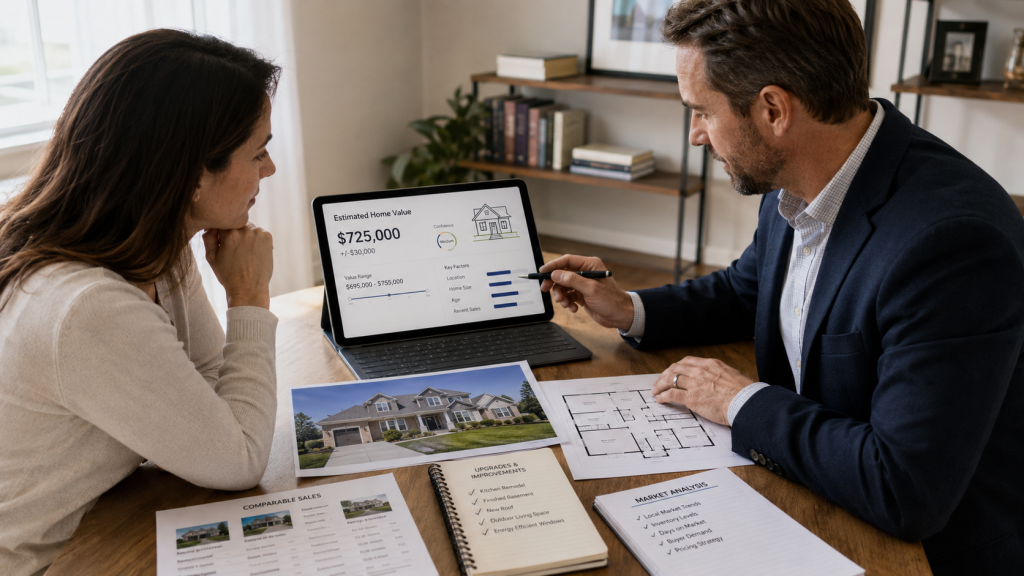
If you have seen a Zestimate or an online estimate that feels too high or too low, you are not imagining it. These tools are based on automated algorithms, and they cannot evaluate your home the way a buyer does.
This article explains what online estimates do well, what they miss, and what actually drives value when it is time to sell.
What Online Estimates Are Based On
Most online estimates rely on:
- Public records.
- Recent nearby sales.
- Basic home details like square footage and bedroom count.
- Market trends at a broad level.
That data can be useful, but it is limited.
Algorithms cannot reliably account for:
- Condition and quality of updates.
- Layout and functionality.
- Lot location, corner lots, or busy streets.
- Views, privacy, and neighborhood micro differences.
- How a home shows in person.
- Buyer demand within a specific price range.
Those details are often the difference between an average sale and a strong one.
Why Two Similar Homes Can Sell Very Differently
From a distance, two homes can look identical on paper. In real life, buyers compare homes in a much more detailed way.
Value is influenced by:
- How updated the kitchen and bathrooms feel.
- The age and condition of major systems.
- Natural light, ceiling height, and overall flow.
- The feeling a buyer gets when they walk in.
- How well the home is presented and marketed.
- How the home is priced relative to current competition.
These factors are hard to measure with automated data, but they matter greatly to real buyers. This is often where expectations and reality begin to diverge for sellers.
Common Upgrades Sellers Expect to Get Back
Many sellers expect dollar for dollar return on major improvements like:
- Pools.
- Roof replacement.
- Air conditioning replacement.
- Flooring and general updating.
These improvements absolutely matter. They improve buyer confidence and can make your home more competitive. But they do not always translate into an equal increase in value.
A helpful way to think about it is:
- Some upgrades increase value.
- Some upgrades protect value.
- Some upgrades improve marketability and reduce objections.
All three are important, but they do not function the same way.
What Pricing Strategically Really Means
Pricing is not just a number. It is a positioning decision.
A strong pricing strategy considers:
- Recent comparable sales, not just active listings.
- Current competition and buyer behavior.
- Condition and presentation.
- How quickly you want to sell.
- How much negotiation room you want.
Pricing too high can create more stress later. Pricing accurately can create momentum and stronger buyer interest.
Learning more about the selling process can help explain how pricing, preparation, and buyer expectations work together.
Questions to Ask Before You Trust an Online Value
If you are looking at an online estimate, ask:
- Does this estimate account for my home’s condition and upgrades?
- Does it compare my home to truly similar homes?
- Is it using recent sales or older data?
- Would a buyer see my home as equal to the homes it is comparing?
If the answer is unclear, that is a sign the estimate is only a rough starting point.
A Calm Way Forward
Online values can be a useful reference, but they should not be the deciding factor in a major financial decision.
If you are curious about what your home could sell for in today’s market, a clear analysis that compares apples to apples and reflects buyer behavior can provide clarity without pressure.
If you would like help understanding your home’s position in the market, I am happy to walk through it with you.